

Explaining ME/CFS
How to talk to other people about ME/CFS
We consider just how much of an added burden it can be when others in your life do not understand ME/CFS, and we examine ways in which communication can be improved.
Medical Disclaimer
This leaflet is not intended to be a substitute for personalised medical advice or treatment. You should consult your doctor whenever a new symptom arises, or an existing symptom worsens. It is important to obtain medical advice that considers other causes and possible treatments. Do not assume that new or worsened symptoms are solely because of ME/CFS or Long Covid.
- Introduction by ME Connect
- Helping your GP to understand ME/CFS
- What exactly is ME/CFS?
- Disability Rating Scale
- Meeting people in more formal situations
- ME/CFS and your symptoms
Introduction by ME Connect
Katharine Leat, ME Connect Manager,
Katharine heads an amazing team of staff and volunteers who provide support and information to anyone whose life has been affected by ME/CFS or Long Covid.

It is difficult when people don’t understand ME/CFS. They don’t know how you are feeling, so how can you explain to them how unwell you really are?
Begin by telling people how your illness started and how you feel. Short explanations are best; just tell people the three or four main symptoms you have.
Your family and friends may like to read a little about ME/CFS so we have included a description of the condition and its severities to help them to understand it more clearly. Our disability rating scale is also included.
The ME Association has an extensive range of reliable literature about PVFS, ME/CFS, and Long Covid, written by Dr Charles Shepherd, other advisers, and topic experts. This literature is all free to download from the ME Association website: https://meassociation.org.uk/free-literature-downloads/
Unfortunately there may be people in your life who just don’t understand ME/CFS or don’t believe the illness exists. This can be hard to accept, so let’s look at some of the comments or questions you may receive and the ways you could respond to them.
I don’t believe in ME/CFS. It’s just a psychological illness.
ME/CFS is actually a physical illness, listed as such by the World Health Organisation. It makes me feel really unwell. Perhaps I
could tell you a little about it?
You looked ok when you were out yesterday
People with ME/CFS often look well, but I feel ill for much of the time. When you see me out and about, it means I am having a
better day! When you don’t see me, it is usually because I am too exhausted or unwell to go out.
You were well enough to do emails this morning so why can’t you cook the tea now?
Because I’ve got no energy left. I am exhausted. ME/CFS is a fluctuating condition, I can have good mornings and bad ones. If I do too much then I have to rest or I’ll collapse.
You would feel better if you did more exercise / you are too scared to exercise
I love doing things, always have but people with ME/CFS suffer from what is called post-exertional malaise. It means I feel shattered the day after I’ve used too much energy. It works better for me to pace myself and to manage my energy levels. I get tired as well but I don’t make so much fuss about it.
ME tiredness is different to normal tiredness. Sometimes I don’t even have the energy to stand. And I can still feel tired after a good night’s rest.
You just don’t want to work
I actually love working. It would be a joy to be well enough to work. It is hard to manage without the money from work and I miss my job very much.
Try to use an image where you can. If, for example, you are asked:
Why are your legs weak and wobbly, you haven’t done very much today?
Because I’m ill, my legs have no strength in them. There are more than 402,000 people like me with ME/CFS and we feel weak and wobbly when we have used up our limited amount of energy. People with ME/CFS, especially when they are tired all the time, feel weak and wobbly. At the moment, my legs feel as if I have cycled 10 miles.
Another example of using an ‘image’ is to ask people how they felt when they had flu or another debilitating illness:
Do you remember how you felt when you had the flu and how awful you felt? People with ME feel like that for much of the time.
Tell people that you are not well, or that you have a debilitating illness. Explain, briefly, what you can and can’t do, together with what help and support you need.
Please do call ME Connect if you need more help to explain your illness to your GP, family and friends. We are here to help you.
ME CONNECT SUPPORT LINE
If you need to talk in confidence about anything to do with ME/CFS, please call our ME Connect helpline.
CALL FREEPHONE: 0808 801 0484
For up-to-date opening hours please visit: https://www.meassociation.org.uk/me-connect
HELPING YOUR GP TO UNDERSTAND ME/CFS
Do you want your GP to understand more about ME/CFS? The ME Association is working positively with colleagues in the NHS and social care to implement the recommendations set out in the 2021 NICE Clinical Guideline on ME/CFS.
We are also part of the 2022-25 Government initiative to improve healthcare provision, understanding, awareness and biomedical research investment, working with the Department of Health and Social Care and the established working groups.
There is a section on our website specifically for healthcare professionals: https://meassociation.org.uk/healthcare-4-me/information-healthcare-professionals/
We recommend our clinical guidance book ME/CFS/ PVFS: An Exploration of the Key Clinical Issues, written by Dr Charles Shepherd. This is the most comprehensive, evidence-based summary of ME/CFS/ PVFS currently available. It contains everything that health professionals, patients, and the people who care for them need to know about ME/CFS/PVFS:
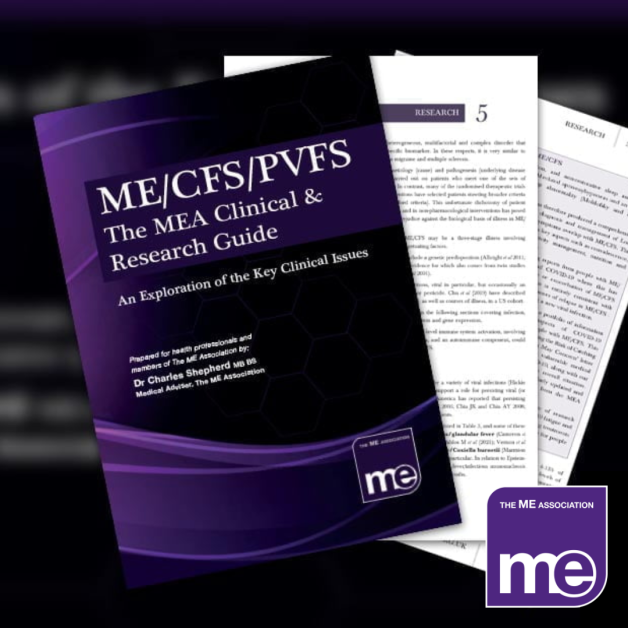
The ME/CFS/PVFS & Long Covid Clinical and Research Guide (Purple Book)
The ME/CFS/PVFS & Long Covid Clinical and Research Guide (Purple Book) is the most comprehensive, evidence-based summary currently available, and contains everything that healthcare professionals need to know about this devastating neurological disease.
We will send a free copy to UK subscribers when it is next updated.
Hard copies are also available to buy from our shop (UK only), or Kindle version on Amazon.
We have a quarterly ME Medical magazine specifically produced for healthcare professionals. Healthcare professionals can register themselves and people with ME/CFS or their friends or family members sign up to nominate them for subscription.
WHAT EXACTLY IS ME/CFS?
ME/CFS (myalgic encephalomyelitis/chronic fatigue syndrome) is a complex multisystem illness that affects the brain and muscle function and, in some cases, other body systems as well. It often causes prolonged ill-health and disability.
Although many uncertainties remain about the cause of ME/CFS, research has demonstrated abnormalities involving the brain, muscle, immune and endocrine (hormone-producing) systems.
ME/CFS is classified by the World Health Organisation as a neurological disease.
The visible signs and restrictions that people normally associate with being ill or disabled may not always be obvious in someone with ME/CFS.
So a person with ME/CFS may look perfectly well and may have no obvious signs of problems relating to either how they can care for themselves or their ability to walk and get about.
ME/CFS is characterised by brain and muscle symptoms that are always made worse by minimal physical or mental exertion – something that is referred to as post-exertional malaise.
The severity and range of ME/CFS symptoms varies from person to person. Symptoms and their severity can vary throughout the day, from day to day, from week to week and from month to month. ME/CFS is therefore known as a fluctuating medical condition – a medical term that is particularly important in relation to benefit and other assessments. These symptoms can also, on occasion, vary quite suddenly – so a person’s health can deteriorate quite rapidly, leading to complete exhaustion.
DISABILITY RATING SCALE
The NICE Guideline on ME/CFS publishes the following disability rating scale:
MILD ME/CFS
People with mild ME/CFS care for themselves and do some light domestic tasks (sometimes needing support) but may have difficulties with mobility. Most are still working or in education, but to do this they have probably stopped all leisure and social pursuits. They often have reduced hours, take days off and use the weekend to cope with the rest of the week.
MODERATE ME/CFS
People with moderate ME/CFS have reduced mobility and are restricted in all activities of daily living, although they may have peaks and troughs in their level of symptoms and ability to do activities. They have usually stopped work or education, and need rest periods, often resting in the afternoon for 1 or 2 hours. Their sleep at night is generally poor quality and disturbed.
SEVERE ME/CFS
People with severe ME/CFS are unable to do any activity for themselves or can carry out minimal daily tasks only (such as face washing or cleaning teeth). They have severe cognitive difficulties and may depend on a wheelchair for mobility. They are often unable to leave the house or have a severe and prolonged after-effect if they do so. They may also spend most of their time in bed and are often extremely sensitive to light and sound.
VERY SEVERE ME/CFS
People with very severe ME/CFS are in bed all day and dependent on care. They need help with personal hygiene and eating, and are very sensitive to sensory stimuli. Some people may not be able to swallow and may need to be tube-fed.
DOWNLOAD THE NICE GUIDELINE HERE
The ME Association has produced a new booklet, MEA Disability Rating Scale on ME/CFS, that expands on the illness severity definitions recommended in the NICE Guideline on ME/CFS. It is more detailed and relevant, can be used to explain your current situation to others, in medical or benefit discussions, and as an aid to monitoring progress.
You can download a free PDF file of this booklet here: https://meassociation.org.uk/literature/items/disability-rating-scale/
MEETING PEOPLE IN MORE FORMAL SITUATIONS
In hospital you may well find that some of the staff already know and understand about ME/CFS, but at college or work this may not be the case. If you are going back to work, going into hospital, off to college or going anywhere where you will meet people who will need to know about ME/CFS but may not have a full understanding of this illness, it may be helpful to take with you something to give to them to help explain your symptoms.
In hospital you may well find that some of the staff already know and understand about ME/CFS, but at college or work this may not be the case.
Leaflets that you may find helpful:
- Hospital Support Pack
- A short-form summary on Anaesthesia and ME/CFS
- University & How to Survive by Emily Bailey
- Employment issues
ME/CFS and your symptoms
The PDF download of this leaflet (button at top of this page) contains forms you can complete with your symptoms and frequencies (all of the time, most of the time, some of the time), including the following:
- Activity-induced fatigue Pain:
- In my muscles
- In my joints
- In my nerves
- In my glands
- Muscle twitching or spasms
- Cognitive dysfunction / brain fog
- Dizziness or balance problems
- Headaches (tick if migraines)
- Sensory problems:
- Sensitivity to loud noises
- Sensitivity to bright lights
- Sensitivity to smells – e.g. to perfume
- Sensitivity to temperature change
- Numbness
- Pins & needles
- Sleep disturbances:
- Hypersomnia – excessive sleep
- Frequent night-time wakening
- Unrefreshing sleep
- Allergies:
- Drugs
- Chemicals
- Palpitations
- Low blood pressure (leading to faintness when standing up)
- Orthostatic intolerance (unable to maintain upright posture)
- Cold hands and feet Sore throats
- Enlarged glands
- Irritable bowel syndrome Nausea and sickness
- Eye Problems Dry eyes
- Hearing problems (Tinnitus – strange noises in the ear)