
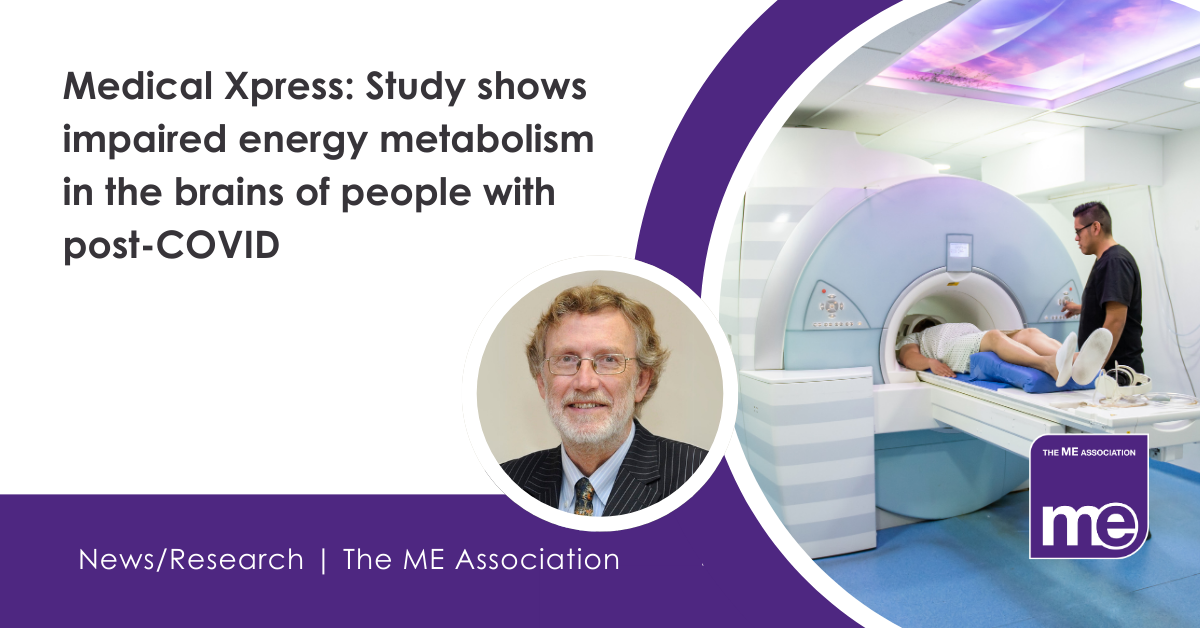
On the 9th of February, Medical Xpress reported on a new research paper published in the journal Biological Psychiatry, titled ‘Reduced ATP-to-phosphocreatine ratios in neuropsychiatric post-COVID condition: Evidence from 31P magnetic resonance spectroscopy'. Dr Charles Shepherd provides comment below.
AI Summary
- Brain scans showed that people with post-COVID condition had lower levels of energy-related molecules in an area called the cingulate cortex. Lower energy levels in one specific part (the anterior cingulate cortex) were directly linked to worse performance on thinking and attention tests.
- The results suggest that problems with how brain cells produce and regulate energy—possibly involving the mitochondria (the “power plants” of cells)—may play a key role in long COVID and could help guide future treatments.
Extracts
The study team at the Central Institute of Mental Health (CIMH) in Mannheim used a special variant of magnetic resonance imaging (MRI) in the NEULOCO study, known as phosphorus magnetic resonance spectroscopy (31P-MRS). This procedure makes it possible to examine certain high-energy phosphates in the living brain (in vivo) that are crucial for cell metabolism. The researchers were interested in adenosine triphosphate (ATP)—simply put, the “fuel of the cell”—and phosphocreatine (PCr), a “short-term energy store” that can quickly replenish ATP.
The study examined 27 patients with post-COVID condition and 23 control subjects who had fully recovered from SARS-CoV-2 infection. In addition, all participants completed cognitive tests, the results of which were compared with the metabolic measurements.
This enabled the researchers to detect a reduced ATP to PCr ratio (ATP/PCr) in people with post-COVID condition. This suggests that the supply of energy for cell metabolism in the brain may be impaired.
MEA Comment
It's now over 40 years since The Lancet published the results of some research that I was involved with and used the same neuroimaging technique (ie 31P nuclear magnetic resonance) to look at and demonstrate a clear abnormality in the way that energy is being produced in skeletal muscle (ie muscle energy metabolism).
Since then we know from other research that there are defects in the way that mitochondria, the battery like structures at a cellular level that help to create energy, are defective in ME/CFS – which helps to understand why activity induced fatigue is a key feature of this illness.
What isn't always appreciated is that mental activity in relation to memory, concentration, word finding ability etc also requires a lot of energy and this research, which has used 31P neuroimaging to look at energy metabolism in the brain, provides further evidence of mitochondrial dysfunction in Long Covid – as is the case in ME/CFS.
And while there are neuroimaging studies that have found evidence of metabolic abnormalities in the brain in ME/CFS, it would obviously be useful to repeat this particular research in ME/CFS in view of the overlaps between ME/CFS and Long Covid.
Dr Charles Shepherd,
Trustee and Hon. Medical Adviser to the ME Association,
Member of the 2018-2021 NICE guideline on ME/CFS committee,
Member of the 2002 Chief Medical Officer's Working Group on ME/CFS
