
The ME Association Clinical Assessment Toolkit
(MEA-CAT) is now here!



The MEA-CAT project was funded by The ME Association and led by Professor Sarah Tyson (University of Manchester), who also has ME/CFS.
The MEA’s Clinical Assessment Toolkit (MEA-CAT) is primarily a research project that has developed a series of questionnaires which detail ME/CFS symptoms (including a separate questionnaire about post-exertional malaise), activity levels, clinical needs and satisfaction with NHS ME/CFS specialist services. Together, these form the toolkit.
This type of questionnaire is often referred to as a Patient Reported Outcome Measures (or PROMs) but they do much more than merely measure outcome. They produce information to help you and clinicians better understand your difficulties and open up discussions about how to manage them. This then supports other aspects of care such as making a diagnosis or developing a care and support plan. The Toolkit can also be used to track changes over time and produce report summaries that can be shared with others (e.g. family, other health or social care professionals or employers).
Professor Tyson’s work with other long-term disabling conditions has shown that using an assessment toolkit can streamline the assessment process. It improves understanding of patients’ problems, facilitates communication (between patient and professionals, and between professionals) and speeds up decision-making.
When you first see a health professional, there is an assessment process – that’s when there are lots of questions, tests etc, to gather the information needed to understand your difficulties. But this is easier said than done. Not only does ME/CFS cause a wide range of problems, but many are difficult to explain, especially when you are newly diagnosed. The questionnaires are all relevant to ME/CFS and completing the Toolkit makes the assessment process easier. It means that people with the condition can complete the Toolkit in their own time and pace, knowing that nothing important has been missed. It also helps you think through the problems you are having and what you might want or need to do about it.
The use of PROMs is an established element of good quality care and NHS specialist services are expected to use them. However, there are few PROMs designed for ME/CFS, so specialist services end up using ones that were made and tested for other conditions, or ones based on an ‘outdated’ understanding of ME/CFS. Consequently, they often miss out issues which are important to people with ME/CFS or ask questions that are irrelevant. Also, some are poorly designed and do not produce good quality information. The aim of the MEA-CAT project was to fix that. The project has been led by – and co-produced with – people with ME/CFS and included people whose trigger was Covid-19. It incorporated extensive feedback from thousands of people in the patient community. This truly is patient-led research. It has ensured the questions asked are important and relevant to people with ME/CFS, that the questionnaires produce robust information, and that they are as easy as possible to use.
Phase I of the project is complete and Phase II is in progress
The toolkit is now available to anyone who wishes to use it. It is available digitally via the Apps (one for clinical services to use and one for the public). It is quicker and easier to complete the toolkit digitally as the scores are calculated automatically, but hard copies to download are also available to maximise access.
The second phase will:
- Disseminate findings via peer-reviewed publications.
- Expand the toolkit with three new resources (which could include a co-morbidities checklist, a care and support plan template, and a version of the Toolkit for children and young people).
Professor Sarah Tyson
Further information is found in the FAQs below, or if you have any questions, please contact Professor Tyson at sarah.tyson@Manchester.ac.uk

The ME Association App
An App has been launched featuring the Clinical Assessment Toolkit and access to ME Association support and information.
Features
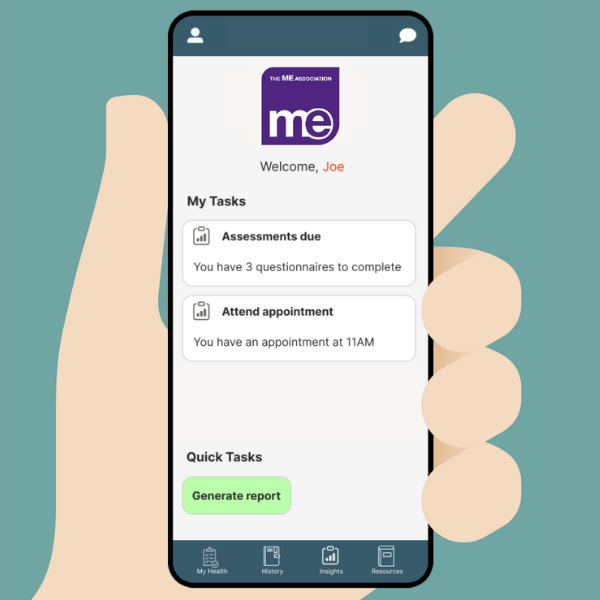
- Access the MEA-CAT to assess:
- Symptom burden using the TIMES,
- PEM using the PASS,
- Clinical needs using the CNAME,
- Patient experience using the PREM
- Activities using the MEAQ.
- Share clinical reports with clinicians, employers, carers or family.
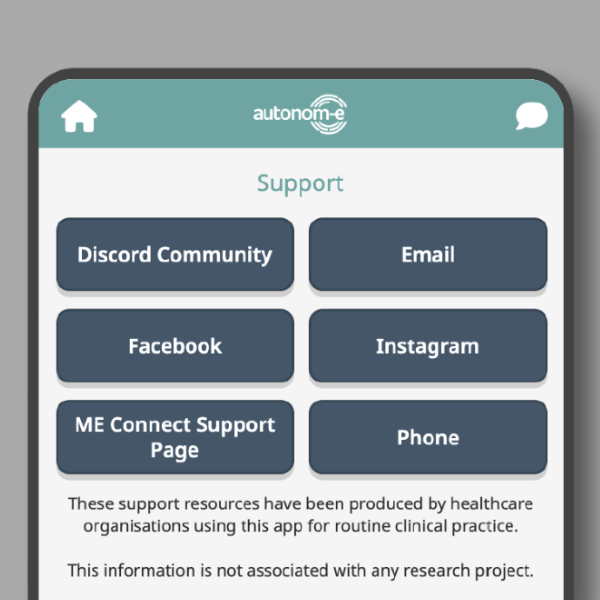
- Access information and support from the MEA.
This app is intended for:
- People who want digital access to the MEA Clinical Assessment Toolkit
- People who are not already using the NHS-version of the App with a clinician
- People who are unable to receive a referral to an NHS ME/CFS specialist service
- Clinics and Health Insurers, globally, that want to purchase a cost-effective licence for their patients
Benefits
- Free to download, to use the MEA-CAT and to access MEA resources
- Access to validated and relevant clinical assessment tools
- More convenient completion of the Toolkit
- Can help with monitoring the impact of ME/CFS
- Provides access to MEA information and support
- An optional subscription to share health reports with whomever you choose
- Can be used without needing a referral to an NHS ME/CFS specialist service

Get the app
- Download “autonom-e” from the app store / google play
- Click ‘Create an account’
- Register with the MEA-CAT
- Complete the TIMES, PASS, CNAME, MEAQ, PREM-ME
- Access MEA Resources
- Share validated health reports with whomever you choose
The Toolkit
There are four assessment tools available currently. You can also download a Word version of each form on the buttons below, to save and complete. Please check your downloads folder.
The Index of Symptoms (TIMES) to assess your ME/CFS symptoms
There are also sub scales which assess more specific issues and which can also be used as standalone assessments. Downloads available on each listed item:
The Post Activity Symptom Scale (PASS) to assess post exertional malaise
The Clinical Needs Assessment for ME (CNAME) to measure clinical needs
i.e. what is important to you and you wish to address with the service
The Patient Reported Experience Measure for ME (PREM-ME) to assess patient satisfaction
FAQs
Resources
In this section we have made papers and presentations about the project available.
- TIMES
- Development and psychometric evaluation of The Index of ME Symptoms (TIMES) Paper 1: Development and Rasch Analysis.
- Development and psychometric evaluation of The Index of ME Symptoms (TIMES) Paper 2: Classic Theory testing – validity, reliability and minimal detectable difference.
- Mapping the Symptom Profile and Burden of ME/CFS: Insights from the TIMES Survey
- CNAME