
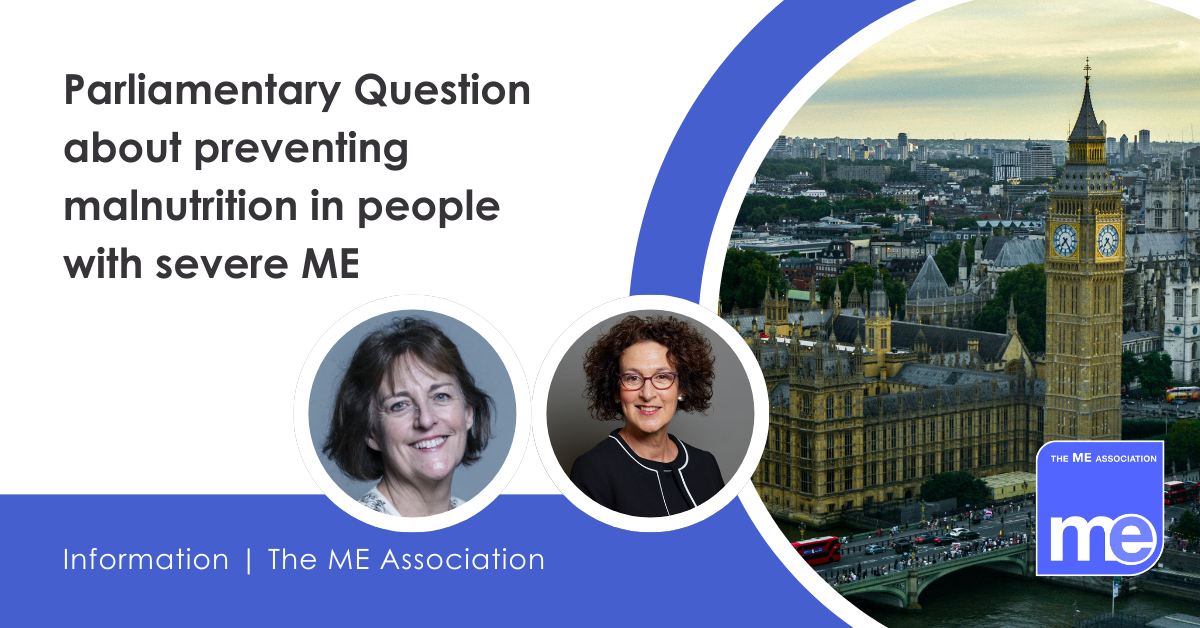
Photo of Baroness Scott of Needham Market and Baroness Merron © House of Lords / photography by Roger Harris, both cropped and shared under the Attribution 3.0 Unported (CC BY 3.0) licence.
Baroness Scott of Needham Market (Liberal Democrat), member of the House of Lords, asked the following parliamentary question about prevention and management of malnutrition in people with severe ME on the 13th November 2025. This question was then answered by Baroness Merron (Labour), member of the House of Lords, on the 25th of November. Read their statements below, alongside Dr Charles Shepherd, MEA Hon. Medical Adviser's, response.
Question from Baroness Scott of Needham Market:
To ask His Majesty's Government what steps they are taking to ensure that hospital and community services effectively prevent and manage malnutrition among people with severe and very severe myalgic encephalomyelitis in England.
Answer from Baroness Merron:
We published the final delivery plan for myalgic encephalomyelitis, also known as chronic fatigue syndrome (ME/CFS), on 22 July, which focuses on boosting research, improving attitudes and education, and bettering the lives of people with this debilitating disease.
The commissioning of ME/CFS services is the responsibility of local integrated care boards based on the needs of their local population. The ME/CFS Final Delivery Plan includes an action for the Department and NHS England to explore whether a specialised service should be prescribed by my Rt Hon. Friend, the Secretary of State for Health and Social Care, for very severe ME/CFS. Officials from the Department have commenced discussions with NHS England on how best to take forward this action.
To support healthcare professionals in the diagnosis and management of conditions like ME/CFS, the National Institute for Health and Care Excellence (NICE) published guidance for ME/CFS in October 2021, a copy of which is attached.
It recommends that people with ME/CFS should be referred for a dietetic assessment by a dietitian with a special interest in ME/CFS if they are losing weight and at risk of malnutrition. The guidance also states that clinicians should recognise that symptoms of severe and very severe ME/CFS may mean that people are unable to eat and digest food easily and may need support with hydration and nutrition, and that the support provided could include oral nutrition and enteral feeding.
NICE guidelines are evidence-based, informed by clinical expertise, and represent best practice. Although NICE guidelines are not mandatory, healthcare professionals are expected to take them fully into account.
ME Association Comment:
Baroness Scott of Needham Market is a very conscientious member of the House of Lords.
She also maintains a keen interest in issues relating to ME/CFS.
Her parliamentary question on the prevention and management of malnutrition in people with very severe ME/CFS in both the community and hospital links in to a meeting that I recently attended with NHS England.
This was to discuss an action item in the DHSC Delivery Plan for NHS England and the DHSC to develop a clinical care template for people with mild to moderate ME/CFS.
We are trying to arrange another meeting with NHS England to discuss a separate action point in the Delivery Plan for specialist care of people with very severe ME/CFS.
Dr Charles Shepherd,
Trustee and Hon. Medical Adviser to the ME Association,
Member of the 2018-2021 NICE guideline on ME/CFS committee,
Member of the 2002 Chief Medical Officer's Working Group on ME/CFS
