
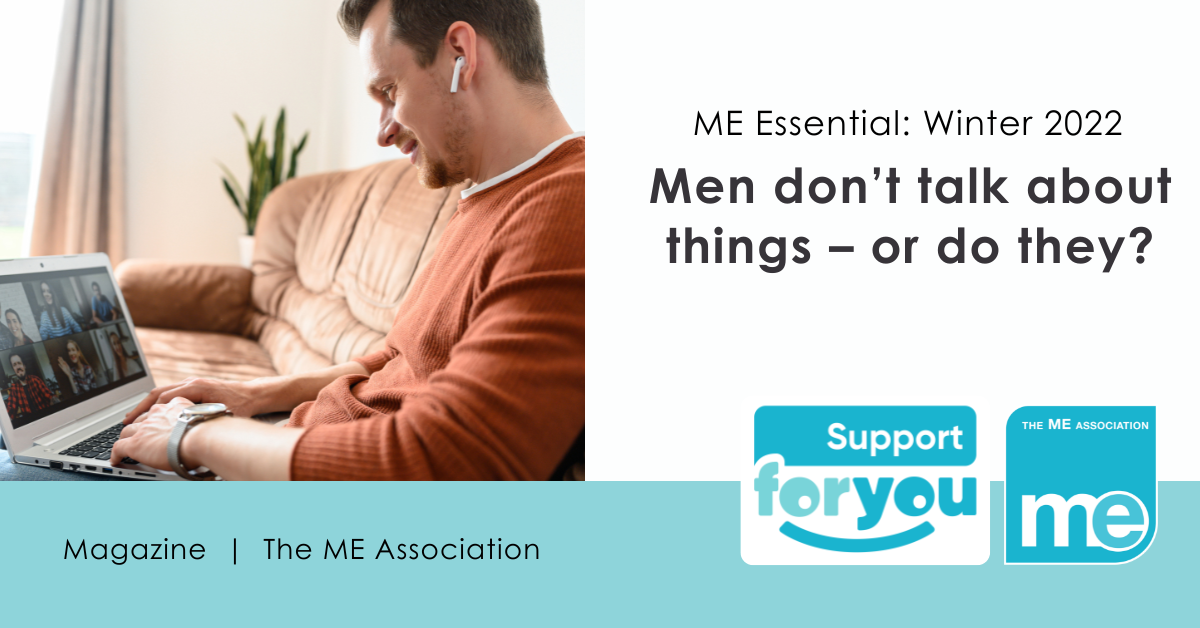
Along with ME/CFS, David, who also suffers with Postural Tachycardia Orthostatic Syndrome (PoTS), chooses to get on with life as best he can, seeing what he can do, rather than what he can’t…
For a good part, if not most of my life, I’ve lived with health conditions that took many years to diagnose. Like many others, there were many challenges in getting a correct diagnosis. Living with the conditions, being male and 49 years old is an extra layer of complexity. I’m married with two children aged nine and 11.
The conditions are complex – along with ME, I have Postural Tachycardia Syndrome (PoTS), particularly bad Gastroparesis, Mast Cell, and considerable Muscular Pain (Fibromyalgia) to name some. However, I’ve chosen to get on with life as best. I can – seeing what I can do, rather than what I can’t.
Taking PoTS, I attend the Zoom led PoTS UK Peer Support Groups, which have been great – but I’m usually the only male, and often one of the oldest. Whilst experiences of PoTS vary widely, regardless of age or gender we have much common ground, and even if we don’t, hearing other stories helps to validate our own experiences, so in part that doesn’t matter.
I don’t meet many men in a similar situation, and there are limits to the relationships I can build with women. This creates a sense of isolation and I sometimes feel like a monk. As sexist and outdated as they may be, there are male stereotypes that some knowingly or unknowingly still have – such as men being the breadwinner, being strong (emotionally and physically) and being self sufficient to name some.
But our conditions challenge that – there can be a sense of shame in being a father but not going out to work each day, in having to rely on others, in not having big achievements, in not having the flashy car, ‘enough’ friends, or house extension, etc.
It’s 30 years since I left school, I was recently invited to a reunion of my year group. I went to a boys-only private school, some of my contemporaries are heads of schools, medical (lead) consultants, high up in business / the military etc., with salaries and pensions to match.
If I went, what would I have to offer – ‘You remember in 6th form I was unwell, well it’s taken a long time but now I have 9kg of prescriptions that fill four large shopping bags each month – although they don’t make me better, that’s still an achievement to me.’ The reality is that I’m ashamed to go because in a very masculine environment I don’t think I have much to say, or would fit in, or feel normal.
I guess humans, as social creatures, want to be valued. But our conditions can reduce our human / social interactions, altering our value framework, perhaps especially if you’re one of the fewer males with rare health conditions.
My Gastroparesis means I sometimes can only eat 800 calories of food a day (and only 25% RDA of protein, etc.) without additional supplements. My weight dropped to 56kg recently (I’m 6-foot tall). I’m as thin as a rake but that isn’t a male stereotype, opening up issues of body image. Along with my other conditions, I cannot go to the gym, run, keep fit, do mountain peak challenges, etc. – looking at my Facebook account, male friends of a similar age have.
I don’t have these achievements, there isn’t much positive I can write about on Facebook (and no one wants to see what I cooked today – I eat seven small meals a day, so it is hardly a good advert for me!). Nor can I drink alcohol(for several reasons). So as a man, there are issues of weight loss, body image, body shame and what is perceived to be ‘normal’.
So instead of dealing with, say, company sales figures in an important company role, I manage large amounts of daily medication and significant dietary, bowel and bladder issues to name a few, all at a premature age. And so there’s the feeling of weakness, and stigmas attached to having health conditions.
There’s the view from some that men don’t talk about things. Perhaps because I’ve had the conditions nearly lifelong, and because they’re so significant, throughout my life I’ve always worked very hard to seek the medical help I need, I’m not ashamed to talk to my GP about, say, bladder or bowel issues when I need to – or to charities.
But I can understand why some don’t. But at times, some have not believed me. I do talk about them socially, although 30+ years of experience have also taught me I don’t need to discuss my personal life with everyone I meet, especially if ‘my health’ is their only topic of conversation – there is more to my life.
The shame and stigmas can lead some to feelings of low mood, depression and mental health conditions, ironically at a time when we need all the encouragement we can get.
Whether male or female, I strongly believe that, as far as possible, we need to look after ourselves if we have health conditions. To have self compassion and reassurance, etc, learning to forgive ourselves when things go wrong (sometimes frequently in my case even after so many years) – but also acknowledging that our conditions may mean various levels of help from others too.
Regardless of how outdated male stereotypes may be, does compassion/reassurance/forgiving ourselves fit into a male stereotype, and how much is our daily thinking affected by it? What is it to be a man when we don’t meet the (even outdated and sexist) expectations of us?
Then there’s being part of a family – a husband, father, son, brother and son-in-law, etc. Despite my conditions, being a father is so important to me, something I put a lot into, trying to be a supportive, caring, listening, fun parent, a role model, who gives so much, but which our conditions can compromise in varying degrees.
For me, it’s looking at what I can do, not at what I can’t, and I’m privileged to have done so much with my children in the past 11 years. When I’m long gone, I want my children to remember the positive times spent with me, lot my conditions.
There has been a ray of sunshine for me recently. PoTS UK in the past year has run Zoom-led Peer Support Groups, run by region and/or speciality (e.g. a group for carers) – and we’re starting one just for men as I write. These groups are run by volunteers from PoTS UK allowing those with PoTS to discuss, in a safe space, their own experiences. Whilst there is no substitute for medical advice, this allows those with PoTS to discuss our conditions and management, referring back to our doctors where necessary.
I’ve long sought similar-minded people to talk to, face to face, but pre-COVID this was difficult, simply due to the rarity of these conditions. By attending these groups most months, over time, with some patience in understanding how the groups work, I have found them to be hugely beneficial forum, for two reasons.
Firstly, hearing other people’s stories validates my own experiences – I’m not the only one to have been through X I’ve discovered. This has been hugely reassuring and reduces a sense of isolation with these conditions, and gives me confidence.
Secondly, listening to other people’s experiences makes me think – should I try Y – is it safe for my situation, and what medical advice should I seek?
With a Men’s Only group, I hope this would be enhanced further, validating my experiences as a man. So how should I conclude this article? I’m sorry that there’s no magical answer to deal with the issues that are relevant to me. There’s the phrase ‘one door closes, another one opens’. If only life were that simple. A more accurate one for my situation might be ‘many doors closed, I had to try another 100 to find one that opened’
ME Essential is the quarterly members' magazine
It is full of exclusive articles, scientific developments, plus stories from people with ME/CFS or Long Covid. Join the ME Association today and get your copy!
Information
- MEA Booklet: Postural Orthostatic Tachycardia Syndrome (PoTS)
- MEA Booklet: Orthostatic Intolerance (OI)
- MEA Booklet: Fibromyalgia & ME/CFS
- UK Charity: Fibromyalgia Action UK
- UK Charity: Guts UK
- UK Charity: Postural Tachycardia Syndrome (PoTS) N.B The information surrounding exercise for PoTS would need to be modified for people with ME/CFS in relation to pacing, activity and energy management.
- MEA information on Gastroparesis
- MEA Medical Matters: Mast Cell Disease (written in 2017)