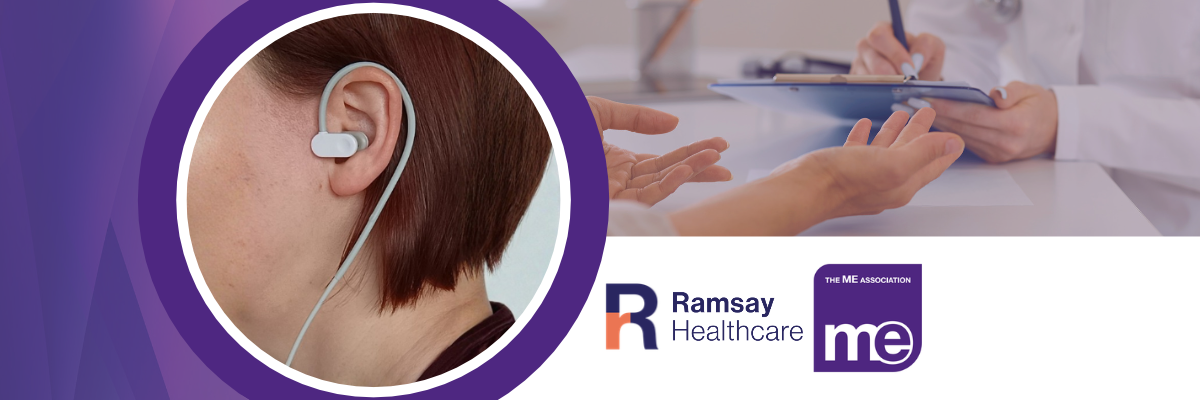
The ME Association has supported the first 3 years of Karen Leslie’s part-time PhD at the University of Liverpool. Her work has been centered around a ‘Feasibility Trial of Transcutaneous Auricular Vagus Nerve Stimulation for People with Myalgic Encephalomyelitis'. This funding has now successfully concluded.
Background
The feasibility trial was led by Dr Nicola Clague-Baker, with Karen Leslie as research assistant (both members of Physios for ME), and they began recruitment in September 2024. The trial aimed to determine how to run a larger study by looking at how easy it would be to recruit people, whether vagus nerve stimulation was safe, and what measurements could be taken.
The vagus nerve is part of the autonomic nervous system and stretches throughout the body, from brainstem to colon. There is some evidence to suggest that electrical stimulation of this nerve at the ear can be used to manage epilepsy, depression, migraine, pain and anxiety, as well as a range of other benefits currently being studied. However, there is limited research evidence to show whether such stimulation devices can relieve ME/CFS symptoms.
The team conducted a survey in 2023 to capture the experiences of 116 people with ME/CFS who had tried various commercially available types of this intervention. 56% reported favourable effects, but 6% reported it made their symptoms worse. The team wanted to use a feasibility trial to support the survey findings and determine if vagus nerve stimulation using an auricular device was safe, if it provided better relief than a placebo, and what outcome measures would best record its effects. The results of this initial trial would help them determine if a larger trial was worthwhile and if so, how it should be structured.
Designed with People with ME
The trial was designed with help from people with ME/CFS. Participants were randomised to receive either the (real) stimulation device, or a sham (placebo) device for 12 weeks. For safety, they were instructed to start at just one minute of stimulation and slowly build up (depending on how they felt), to a maximum of an hour a day. Testing took place at participant's homes to make the trial more accessible. Participants could contact the study team throughout if they had any problems or concerns.
Outcome measures included testing of the body’s processes (heart rate variability, metabolic activity, heart rate and blood pressure in standing) and questionnaires on symptoms and how symptoms affected daily activities. Participants were also interviewed, once after 12 weeks and then again 6 months later. People who had been using the placebo device throughout the 12-week period, were given the real device to use for the next 6 months allowing further comparisons to be made.
Outcomes
The trial aimed to recruit 40 people with ME. Within 48 hours of the announcement being made, there were over 150 volunteers. Of the 40 selected, 38 completed the study. All participants were able to take part in the testing, and many found the tests themselves to be validating. Six cases of undiagnosed postural orthostatic tachycardia syndrome (POTS) were identified, which were flagged to the participant’s GPs.
After 6 months, over 60% of participants were still using the real vagus nerve stimulation, some every day and some intermittently. Some participants reported great benefits, others found it didn’t do anything for them. The most common issue was skin irritation at the ear from the stimulation pads, which was so severe that three people had to stop using it.
Overall, the trial showed it was safe and feasible to test vagus nerve stimulation in people with ME/CFS, but a non-allergenic earpiece is essential. The full results are being submitted to a Journal soon and we hope they will appear in the New Year.
Additional information about the trial
The trial was funded by the Chartered Society of Physiotherapy Charitable Trust Physiotherapy Research Foundation Award. Karen Leslie is studying her PhD as part of this project and has been supported with her university fees by the ME Association.
More Information
- Feasibility Trial of Transcutaneous Auricular Vagus Nerve Stimulation for People with Myalgic Encephalomyelitis
- Vagus nerve stimulation trial: update | March 10, 2026
- Physios for ME: Now recruiting – vagus nerve stimulation study | September 3, 2024
- Lesile et al., 2024. An international survey of experiences and attitudes towards transcutaneous auricular vagus nerve stimulation for people with Myalgic Encephalomyelitis/chronic fatigue syndrome. Fatigue: Biomedicine, Health & Behavior, 12(1), 32–42. https://doi.org/10.1080/21641846.2023.2286029
- Natelson et al., 2023. Transcutaneous Vagus Nerve Stimulation in the Treatment of Long Covid-Chronic Fatigue Syndrome. Archives of Clinical and Biomedical Research. 7 (2023): 239-241. https://doi.org/10.26502/acbr.50170337
- The UK's Clinical Study Registry- A trial of stimulating the vagus nerve at the ear for people with myalgic encephalomyelitis/chronic fatigue syndrome (ME/CFS)