

The MEA had the privilege of attending this reception at the invitation of the B12 Alliance and Pernicious Anaemia Society.
This event saw MPs, researchers, scientists, industry experts, NICE committee, healthcare advocates and patients come together to discuss the importance and accuracy of prompt diagnosis and treatment of B12 deficiency. The event was to advocate for those with chronic health conditions, to push for efficient testing and effective NHS healthcare.
This was an important networking opportunity and information was provided at stands organised by scientists, clinicians and patient experience.
A talk was given by Julian Owen (see below) about the critical importance of effective and timely testing, and by patient Julian of his lived experience and delayed diagnosis. Katrina Burchell (see below), chair of the B12 Alliance and CEO of the PASOC thanked everyone for attending and taking the time to discuss these issues with policy makers.


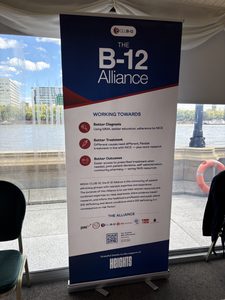

Anaemia affects a possible 350k people in the UK, including 5% of over 65s, 10% of over 70s, and up to 50% of vegans. In the latter case this can be improved with a sufficiently varied diet. In the case of Pernicious Anaemia the only effective treatment is B12 injections. These are typically given in a surgery every 13 weeks, and some patients need them much more frequently. The MEA spoke to people at the event who require injections every 4 weeks, and some even weekly. This is very difficult to get on the NHS due to lack of appointments and patients are not offered the opportunity to inject themselves at home (even in the case of patients who already inject themselves at home for other conditions such as Crohn’s disease ). Without the injections patients suffer a range of symptoms including cognitive issues, memory problems and severe fatigue. These symptoms have a lot of overlap with ME/CFS and Long COVID. These conditions often see patients fighting a long time to be believed and get the healthcare they need.
Advocates are fighting to improve education and awareness, and researchers are working hard to find answers and influence the NHS and policy makers.
Effective testing could be made available for as little as €1(around 86 pence) per test, if done at scale.
The MEA spoke to nutritionists, dieticians, chemists, researchers, doctors specialising in B12 and mitochondria, including Dr. Willemina Rietsema (see below) and scientists including Dr Harry Jarrett from Heights.
Important: Please note that there is no evidence that ME/CFS causes a deficiency of vitamin B12 or iron. So if you are going to take a supplement you should speak to your GP or pharmacist for advice.
Experts in attendance:
- Mr P Julian Owen, Consultant Orthopaedic Surgeon – MA, MB, Bchir, FRCS (Tr & Orth) – Addenbrookes Hospital, Cambridge and Founder of cluB-12
- Prof. Martin Warren, Group Leader, Food Innovation Health Programme at Quadram Insititute Bioscience
- Dr. Willemina Rietsema, Co-chair of the Nutrition and Lifestyle Special Interest Group at Royal College of General Practitioners
- Katrina Burchell, Chair, B-12 Alliance and CEO of PASOC
More Information:
- ME Association Booklet: Vitamin B12 & Deficiency