
Bateman & Horne Introduction
The American College of Sports Medicine’s (ACSM) Guidelines for Exercise Testing and Prescription, for the first time, includes a section on ME/CFS. ACSM is a leading authority on exercise science, and these guidelines serve as a foundational text for exercise professionals to guide safe and effective exercise testing and programming.
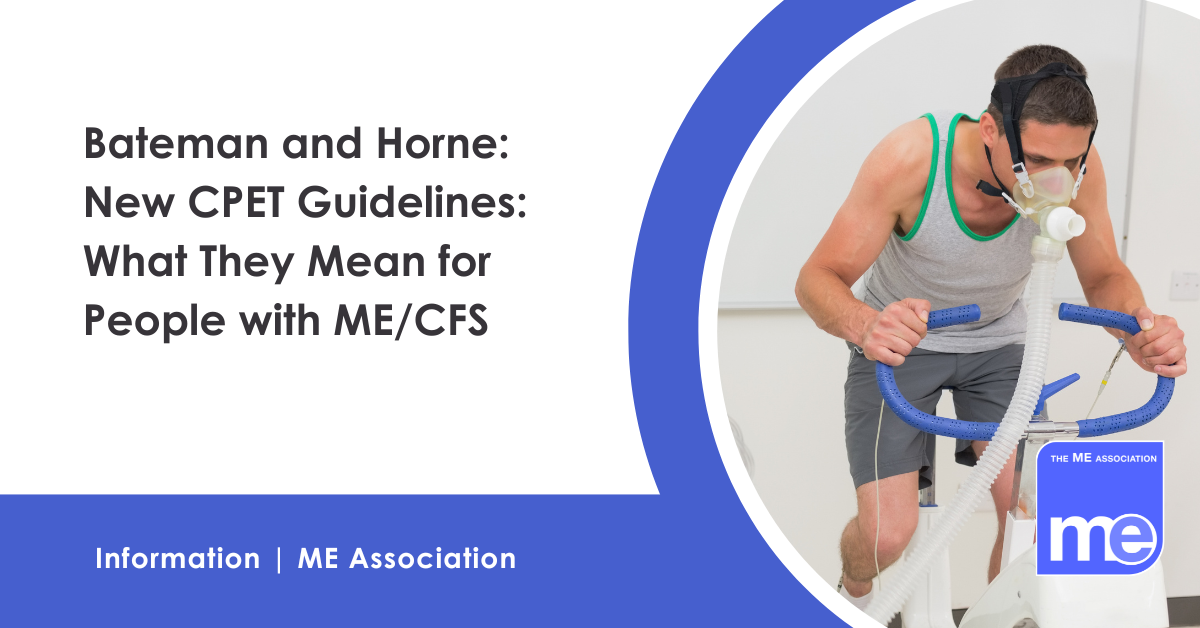
The guidelines were released on the use of cardiopulmonary exercise testing (CPET) in research and clinical practice for myalgic encephalomyelitis/chronic fatigue syndrome (ME/CFS). These guidelines are important because CPET has long been one of the few tools that objectively capture the hallmark feature of ME/CFS: post-exertional malaise (PEM).
What the guidelines recommend
- Two-day testing is essential to reveal PEM. A single test often misses the core dysfunction seen in ME/CFS and Long COVID.
- Patient safety must come first. Due to the exertional nature and intensity of the 2-day CPET patients with PEM may experience a deep or prolonged crash following the testing procedure.
For this reason, guidelines caution against using the test routinely in clinical care. Instead, it should be reserved for research or disability documentation, and only when the potential benefits outweigh the risks. To date, however, it remains the most reliable way to provide clear, objective evidence of the disease. - Adapted protocols matter. The guidelines call for standardized methods to improve accuracy while minimizing the impact of PEM.
MEA Comment
This is a useful summary from the Bateman Horne Centre in America on the pros and cons of using a two day cardiopulmonary exercise test (CPET) in the assessment and diagnosis of people with ME/CFS.
Key points:
- CPET can provide useful information to support a diagnosis of ME/CFS as well as demonstrating that exercise can produce a significant decrease in physical performance and a symptom exacerbation which is delayed to the following day (ie post exertional malaise).
- As CPET involves physical exercise and exertion it can cause an exacerbation or even a relapse of ME/CFS symptoms.
- The NICE guideline on ME/CFS does not therefore recommend that a two day CPET should form part of the list of investigations that are routinely carried out when a diagnosis of ME/CFS is suspected.
- Here in the UK a CPET is mainly regarded as a research tool and is not usually available on the NHS for either diagnosis or disability assessment purposes.
Dr Charles Shepherd,
Trustee and Hon. Medical Adviser to the ME Association,
Member of the 2018-2021 NICE guideline on ME/CFS committee,
Member of the 2002 Chief Medical Officer's Working Group on ME/CFS

Further Information
- The ME Association Medical Matters: Where can I get a two-day CPET test? | Autumn 2023
- Research involving the use of a CPET in ME/CFS is summarised and referenced in the ME Association ME/CFS/PVFS Clinical & Research Guide 2022 Edition (The ‘Purple Book')