

On Monday 3 June, the ME Association (MEA) was invited to a high-level policy meeting with David Smith MP (North Northumberland) and Sir Stephen Timms, Minister for Social Security and Disability.
This meeting followed an earlier roundtable where Ella Smith, the MEA’s Welfare Rights Consultant, had raised significant concerns about the government's proposed Pathways to Work reforms and their likely impact on people with ME/CFS and Long Covid.
The ME Association welcomed this further opportunity to represent the ME and Long Covid community and to share insights into the realities of living with fluctuating * (whereby symptoms are always present ranging in severity), energy-limiting conditions.
These illnesses are characterised by unpredictable and disabling symptoms — such as post-exertional malaise, cognitive dysfunction, and orthostatic intolerance — which require individuals to actively manage their activity levels, even on days when the symptoms are relatively mild.
Revised PIP eligibility rules, including a proposed requirement for claimants to score 4 or more points within a single activity. This would disproportionately affect people whose symptoms are spread across multiple domains and would fail to recognise the cumulative impact of fluctuating or hidden impairments.
*N.B. Where the use of the word ‘fluctuating' is used, this is to align with DWP terminology
Key Concerns Raised
At the meeting, the ME Association challenged several core aspects of the Green Paper:
- The proposed abolition of the Work Capability Assessment (WCA) raises serious concerns, particularly as there is currently no plan to replace Regulations 29 and 35, which provide vital protections for people whose health would be placed at risk by work or work-related activity. These regulations act as a crucial safeguard, allowing claimants to qualify for Employment and Support Allowance (ESA) even if they do not meet the required points threshold—on the basis that engaging in work would be medically unsafe or detrimental to their physical or mental health.
- Revised PIP eligibility rules, including a proposed requirement for claimants to score 4 or more points within a single activity. This would disproportionately affect people whose symptoms are spread across multiple domains and would fail to recognise the cumulative impact of fluctuating or hidden impairments.
- Planned reductions to the Universal Credit LCWRA element, from £390 to £200 per calendar month — a cut from approximately £90 to £46 per week — for new claimants. Payments would also be frozen at this rate until 2029/30, creating a real-terms reduction for future claimants with long-term health conditions.
The Association emphasised that these proposals risk increasing hardship, worsening health outcomes, and pushing more disabled people out of the labour market — the very opposite of what the government intends.
PIP as a Tool for Employment
One of the key messages delivered was that PIP facilitates work — it does not discourage it. PIP helps cover essential costs such as transport, mobility aids, and support with daily living, which can make limited or part-time employment feasible. Removing this support undermines people’s ability to remain in or return to work, and risks deepening social and economic exclusion.
The Association also corrected a common misunderstanding about “fluctuating”* conditions. These are not simply variable — they are unpredictable and involve persistent symptoms. Even on days when symptoms are mild individuals often need to restrict their activity through pacing to avoid serious deterioration. Mandated activity that ignores this reality can lead to physical harm.
Challenging Assumptions About Behavioural Incentives
During the discussion, the Minister referred to expectations that tightening PIP eligibility will drive behavioural changes — implying that some claimants will adapt to the new thresholds by seeking out employment if they lose entitlement.
Ella firmly challenged this assumption and emphasized that such behavioural models fail to reflect the reality of living with long-term, fluctuating conditions like ME/CFS and Long Covid. These are not conditions where motivation or effort can overcome impairment. In fact, pushing beyond one’s limits can exacerbate symptoms and lead to long-term deterioration.
This position is supported by both clinical evidence and lived experience data. As Ella explained, people do not choose dependency — they are navigating illness within the confines of their health. The suggestion that individuals will adjust their behaviour to retain benefits is not only medically inaccurate but also deeply stigmatising.
Ella also responded to Sir Stephen’s reference to the Office for Budget Responsibility’s (OBR) suggestion that claimants, advisers, assessors, and DWP case managers will adapt their behaviour in response to the new 4-point eligibility threshold. This implies that claimants will target higher-scoring activities to qualify, and that assessors will be more inclined to assign these points.
Such assumptions suggest that current decisions are not always correct or consistent — an admission that should prompt serious concern. It also presumes significant investment in assessor and DWP training, alongside a shift in internal culture, to ensure new rules are applied fairly. Without this, the risk of inaccurate or inconsistent assessments remains high.
Sir Stephen compared this to the earlier transition from Disability Living Allowance (DLA) to PIP, where he said assessment behaviours changed over time. However, Ella noted this comparison was misleading. The transition from DLA to PIP involved a fundamental change in eligibility criteria and assessment process — one which saw many long-term DLA recipients lose entitlement. Changes in assessment behaviour do not necessarily lead to improved fairness or accuracy.
What Happens Next?
The ME Association is submitting detailed written evidence to the Work and Pensions Select Committee and continues to meet with parliamentarians to advocate for policy alternatives that are fairer, safer, and grounded in medical and social reality.
As the consultation window draws to a close, the Association encourages MPs to:
- Vote against the reforms in their current form, should they come before Parliament.
- Join the All-Party Parliamentary Groups on ME and on Long Covid to hear directly from affected constituents.
- Raise concerns within party structures, including with the Whips Office and relevant ministers.
- Engage directly with the ME Association to shape future reforms that support — rather than penalise — people with fluctuating conditions.
The Association extends its sincere thanks to David Smith MP and Sir Stephen Timms for their time and engagement. This meeting forms part of the MEA’s wider advocacy efforts to protect the rights, dignity and safety of people with ME/CFS and Long Covid.
Write to your MP
Between now and the 1st July is is imperative that you write to your MP about how the benefit changes will impact you.
See the template letter here:
If you can please also share this graphic widely to encourage other people within the ME/CFS and Long Covid community to do the same – #ListenToME
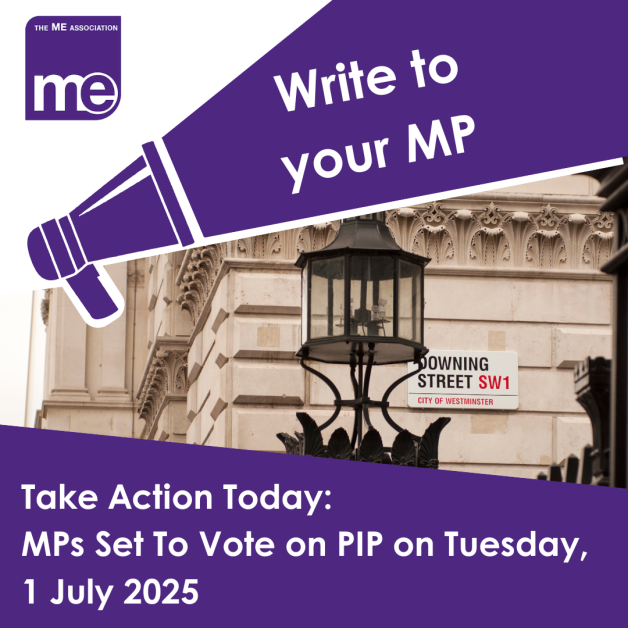
Encourage others to write to their MPs
Use our graphics and suggested text to share the message on social media and encourage others to contact their MPs.
Ella Smith
Welfare Rights Consultant,
The ME Association
