
There are currently no standard diagnostic tests for myalgic encephalomyelitis/chronic fatigue syndrome (ME/CFS) or Long Covid. This leaves many patients facing delayed diagnoses, uncertainty, and limited treatment options.
One promising route forward is the discovery of blood-based biomarkers — measurable biological signals that indicate what is happening in the body. Biomarkers have transformed care in other diseases, including Alzheimer’s, where blood tests are now helping clinicians diagnose and monitor the condition more accurately. Finding similar biomarkers for ME/CFS and Long Covid could be life‑changing for patients and clinicians alike.
About the study
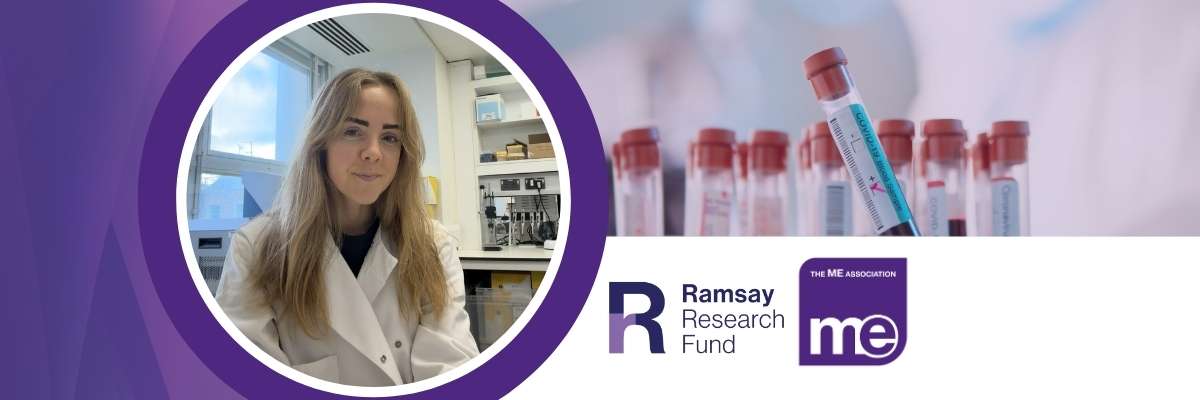
This ME Association pilot funded project, led by Dr Amanda Heslegrave with the laboratory work being conducted by Sophie Hicks at UCL, aims to identify biomarkers that are unique to ME/CFS, unique to Long Covid, or shared between the two conditions. The team is using NULISA, an ultra‑sensitive technology capable of measuring more than 300 inflammation‑ and brain‑related biomarkers from a single blood sample — far more than older technologies could detect.
By comparing ME/CFS samples, Long Covid samples, and healthy controls side‑by‑side, the researchers hope to build the most detailed picture yet of biological changes in these post‑infectious illnesses.
Project progress
The project experienced unavoidable delays earlier this year due to extended legal reviews required for transferring samples, and this led to the MEA recently granting a no-cost six-month extension.
Since then, work has moved quickly:
- All ME/CFS, Long Covid, and healthy control samples have been age‑ and sex‑matched to create a balanced study cohort.
- Samples have been randomised to ensure a robust, unbiased experiment.
- The first major stage of laboratory analysis — a 4.5‑day process using the NULISA platform — was completed on 2 September 2026.
- The team have analysed 259 samples, along with 16 standard control samples. These controls are identical pooled plasma that are run each time, which helps us spot any differences between testing plates and keep the data consistent.
- The second stage, which involves sequencing the resulting DNA libraries (around 8 days of work), is scheduled for completion by early October.
Once both stages are complete, the team will begin sorting and analysing the data. With over 300 biomarkers measured across hundreds of samples, this will be a detailed and careful process — but one that has the potential to reveal important biological insights.
What happens next
Between now and June 2027, the team will:
- Finish all laboratory experiments
- Begin in‑depth data analysis with support from bioinformaticians
- Prepare a preprint for MedRxiv
- Submit a full research paper to an open‑access journal
- Share findings with the ME/CFS and Long Covid communities
Should the results identify potential biomarkers, the team will seek additional funding to confirm and expand these findings.
How our MEA biomarker projects differ
The MEA is currently finding two distinct biomarker projects. The study at UCL, being completed by Sophie Hicks and led by Dr Heslegrave focuses on protein‑based biomarkers rather than metabolites which Aleyna Lumsden is studying at Oxford University.
Using the ultra‑sensitive NULISA platform, Sophie will be measuring over 300 inflammation‑ and brain‑related proteins across ME/CFS, Long Covid, and healthy controls to identify potential diagnostic markers.
In contrast, Lumsden’s work investigates metabolic changes within ME/CFS only, aiming to uncover disrupted biochemical pathways. Together, the studies are complementary, but they explore different layers of biology and answer different scientific questions.
More information
- Neurological and inflammatory Fluid Biomarkers of Myalgic Encephalomyelitis/Chronic Fatigue Syndrome (ME/CFS) and Long-COVID
- New MEA‑Funded Study: Searching for Biological Markers in ME/CFS and Long Covid | February 17, 2026
- Using Advanced Informatics Strategies to Identify Key Disease-Associated Metabolites and Provide Evidence for Infection in ME/CFS Patients
- Research: Spotlight on Aleyna: The PhD Researcher Using Cutting‑Edge Technology to Uncover New Clues in ME/CFS | September 24, 2026
- Research: New funding awarded to PhD project that will identify key metabolites and infection markers in ME/CFS | November 4, 2025