
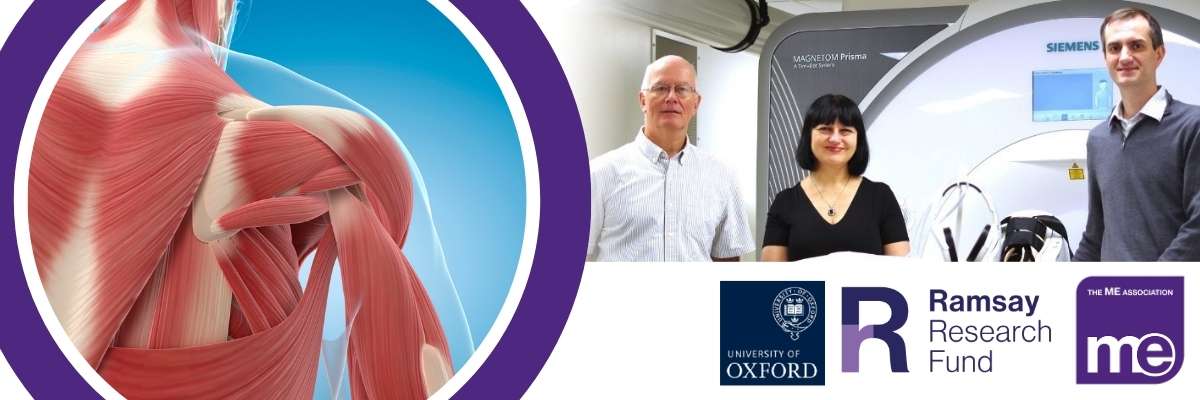
The ME Association is pleased to confirm that Stage 1 of a new study with the University of Oxford and Oxford Brookes University is now underway.
This part of the project was funded by the Big Give campaign, which raised more than £40,000 at the end of last year. Stage 1 began in April and will run for 12 months. As results emerge, we hope to approve the funding application for Stage 2, which is expected to conclude towards the end of next year.
The project is being led by Professor Ladislav Valkovič and Professor Karl Morten at the Oxford Centre for Clinical Magnetic Resonance Research (OCMR) and in collaboration with Professor Patrick Esser at the Centre for Movement, Occupation and Rehabilitation Sciences at Oxford Brookes University.
Project Aims
In this two-stage case-control investigation, Professor Valkovič and his team will examine mitochondrial function in the muscle of people with a mild form of ME/CFS and in people that are healthy (who lead sedentary lifestyles (with light physical activity, e.g., leisurely walking, gentle stretching etc.), using non-invasive magnetic resonance imaging (MRI) and near-infrared spectroscopy (NIRS).
They hypothesise that:
- People with ME/CFS will have decreased mitochondrial function (Stage 1 and 2),
- Repeated MRI and NIRS experiments during PEM will show much slower energy recovery, suggesting exercise-inflated mitochondrial dysfunction as a contributor to PEM (Stage 2).
Introduction
Myalgic Encephalomyelitis/Chronic Fatigue Syndrome (ME/CFS) is characterised by debilitating fatigue and post-exertional malaise (PEM). Mitochondrial dysfunction is a potential underlying mechanism of ME/CFS with its effects intensifying during PEM. Better understanding of this process is vital for improved treatment or even prevention of PEM.
Traditional methods for studying muscle function rely on invasive techniques like muscle-biopsies. For this study, the team will investigate mitochondrial health in calf-muscle using the latest in MRI (magnetic resonance imaging) and NIRS (near-infrared spectroscopy) techniques.
- In Stage 1, which is now seeking participants, the team will establish a baseline and perform a cross sectional study comparing calf-muscle metabolism in people with ME/CFS to people who are healthy and who lead sedentary lifestyles.
- In Stage 2, which depends on additional funding, they hope to perform the mitochondrial assessments at two separate time points; at baseline and then during a mild episode of PEM (triggered by a sub-maximal exercise test on a stationary bike), which they hypothesise will demonstrate a pronounced mitochondrial dysfunction.
Background
We don’t know if muscle energy production and recovery are impaired in ME/CFS, or why mitochondria might be less effective during PEM after physical exertion.
Professor Valkovič and his specialist team within Oxford aim to answer some of these questions and then support larger studies that could improve understanding and move the field closer to the treatment and prevention of key symptoms.
Since oxygen is one of the key components that drives the Krebs cycle, complementary information on mitochondrial effectiveness can be assessed by temporarily reducing blood-flow to a limb and then using NIRS.
This rapid (15 minute) assessment of muscle oxygenation while in a relaxed lying or sitting position involves a small light probe on the skin, emitting and measuring the reflection of haemoglobin in muscular tissue.
In 2023, the team performed a study on patients with hereditary mitochondrial disease, where the NIRS technique successfully measured and monitored mitochondrial function in muscle.1The attractiveness of NIRS is that it does not require big expansive machines like MRI.
The project will enable an unprecedented insight into ME/CFS and PEM, and the team will cross-validate MRI and NIRS as non-invasive measurement techniques.
- Near-infrared spectroscopy (NIRS) is a lightweight and portable testing device that could lead to patients being assessed in large numbers, or it could be used where MRI scans are not possible.
- Magnetic resonance imaging (MRI) provides an alternative option to measure muscle mitochondrial health, without the need to take invasive muscle biopsies.
Performing even a low-level exercise causes the muscle to dip into its energy fuel reserves (phosphocreatine (PCr)), which is replenished by the mitochondria after the exercise ends. Monitoring PCr recovery gives direct and non-invasive insight into oxidative energy production.2
The team has developed a novel muscle-specific localisation technique.3 They recently performed a PCr comparison study in people with Long-Covid. It showed significantly slower recovery of muscle energy reserves.4 While Long-Covid is not recognised as the same condition as ME/CFS, they do share several characteristics, including muscle fatigability and PEM.
This gives the team confidence that with their non-invasive methods they can detect similar mitochondrial dysfunction in people with ME/CFS and, if repeated during PEM, gain essential insight into what might be contributing to this key symptom.
Testing
Professor Valkovič’s team have chosen to stimulate the calf-muscle and observe how the cells respond when energy is demanded. This will involve two different exercise tests:
- MRI experiments will be performed using a whole body 3T MR scanner. Participants will be asked to lie in the MRI machine and complete a plantar flexion exercise. This will involve tensing the calf muscle for 2 seconds and then relaxing for 4 minutes, followed by an 8-minute recovery period, before being repeated.
- Plantar flexion is where the toes are pointed downward away from the body, engaging the calf muscles and the tendons in the foot.
- For NIRS, participants will be asked to sit upright with feet on the floor and to then perform heel-raises (5 seconds tenses, 10 seconds relaxed) for 5 minutes. Blood-flow to the thigh will be restricted and the scan employed. The procedure will then be repeated.
Urine and blood samples will be taken at each visit:
- Urine samples will be taken and analysed to try and replicate the findings made by Professor Maureen Hanson and her team in America:
“Our data suggest that the metabolisms of sedentary individuals who do not have ME/CFS undergo major changes that allow them to recover from exertion, while ME/CFS patients fail to make similar adaptive responses.5
- Blood samples will be taken and then frozen for future research using the clinical data generated by this study. The team would like to:
- Investigate the blood factor potentially driving symptoms in ME/CFS.
- Examine plasma proteomics using new methods which detect >2000 proteins.
- Use state of the art instrumentation at the Rosalind Franklin Institute for metabolomics discovery.
- Develop diagnostic approaches on cells and plasma using a new Raman microscope system, and
- Perform quantitative assessment of micro-clots using flowcytometry.
Stage 1 of this study in Oxford will establish a baseline for both groups of participants. Those with ME/CFS will only need to visit the research site once, while people who are healthy will be asked to visit the site for a second time, during which they will be asked to perform sub-maximal exercise on a stationary bike.
References
- Baskerville R, et al. The Effect of Photobiomodulation on the Treatment of Hereditary Mitochondrial Diseases. J Lasers in Med Sci 2023
- Valkovič L, et al. In-vivo 31P-MRS of skeletal muscle and liver: A way for non-invasive assessment of their metabolism. Anal Biochem 2017(529), p.193-215
- Valkovič L, et al. Depth-resolved surface coil MRS (DRESS)-localized dynamic 31P-MRS of the exercising human gastrocnemius muscle at 7 T. NMR Biomed 2014(27), p.1346-52
- Finnigan L, et al. 1H and 31P MR Spectroscopy to Assess Muscle Mitochondrial Dysfunction in Long COVID. Radiology 2024(313), a. e23317
- Hanson M, et al. Urine Metabolomics Exposes Anomalous Recovery after Maximal Exertion in Female ME/CFS Patients. Int. J. Mol. Sci. 2023, 24(4), 3685