Read the latest updates taken from the UK ME/CFS Biobank Newsletter:
Over the past six months, the UK ME/CFS Biobank has distributed more than 1,300 biological samples to research groups across the world, supporting a diverse range of studies aimed at improving our understanding of ME/CFS. Samples have been provided to Sophie Hicks at the UK Dementia Research Institute, University College London (UCL), Dr Sarah Annesley at La Trobe University, Melbourne, Australia, Dr Robert Baldock, Professor Kempuraj Duraisamy (USA), and Dr Dmitry Pzhezhetskiy(UEA). In addition, more than 100,000 clinical data points have been shared with Dr Francisco Westermeier (Austria) to support further international collaboration.
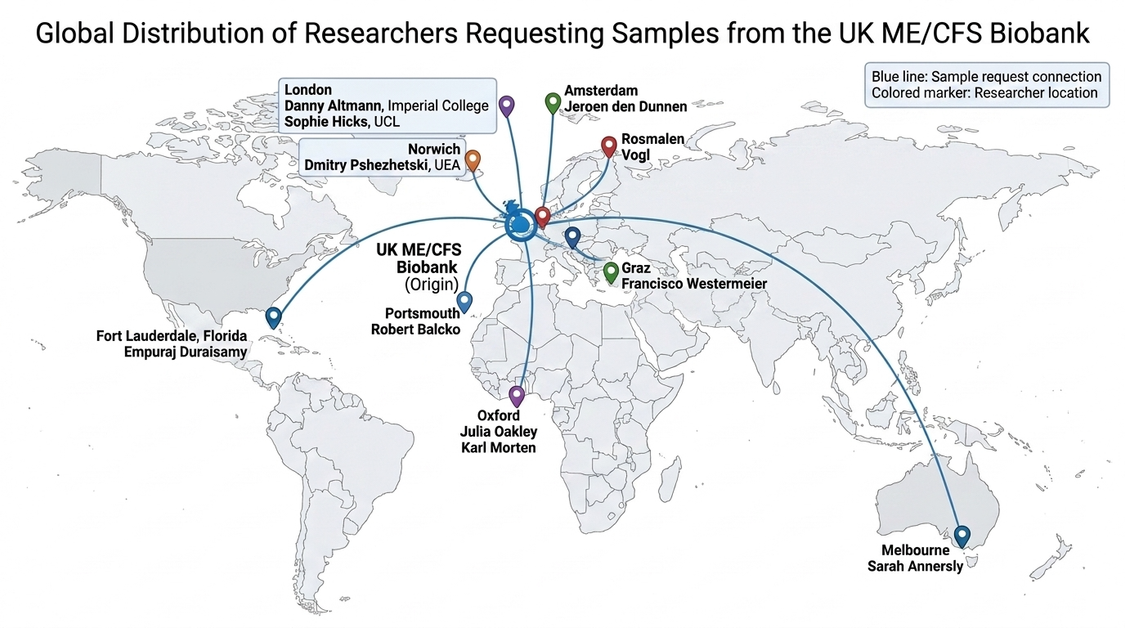
The increasing number of requests for samples and data reflects the continued growth and international recognition of the UK ME/CFS Biobank. This progress has only been possible because of the remarkable commitment of our participants, whose generosity in donating samples and clinical information provides an invaluable resource for researchers worldwide. Greater public awareness and increased media coverage have also played an important role in expanding the Biobank and strengthening its impact.
We extend our heartfelt thanks to every participant, to the ME Association for its continued support in raising awareness and funding, and to all the researchers who are making full use of these precious resources. Together, you are helping to accelerate high-quality biomedical research and bringing us closer to a better understanding of ME/CFS.
Recent Publications
We are pleased to share two recent publications from the UK ME/CFS Biobank and the CureME team.
Our paper, Abnormal T-cell activation and cytotoxic T-cell frequency discriminate symptom severity in myalgic encephalomyelitis/chronic fatigue syndrome, demonstrated that the immunological differences observed between clinical groups are likely to reflect distinct underlying disease mechanisms. These findings strengthen the evidence that ME/CFS is biologically heterogeneous and highlight the importance of stratifying patients in future research.
Our second publication, Overcoming Barriers in ME/CFS Research: the CureME Participatory Model, presents the CureME framework for conducting accessible, participant-centred clinical research. It provides practical guidance on delivering clinical visits that minimise barriers to participation—particularly for people with severe ME/CFS—and offers a model for improving inclusivity and quality in future studies.
More Information:
- Read more about the UK ME/CFS Biobank here.